

 ₹https://connect.vivaacp.com/supplier/-in-ahilyanagar/-in-balikashram-road/viva-composite-panel-pvt-ltd-acp-sheet-aluminium-composite-panel-supplier-in-balikashram-road-ahilyanagar--59B5fT/articles/why-pvdf-coated-acp-outperforms-standard-paint-finishes-in-heavy-rainfall-climates--c62377b7-d43e-4da5-a846-6800d938a11e
Viva Composite Panel Pvt Ltd – ACP Sheet & Aluminium Composite Panel Supplier, Balikashram Road, ahilyanagar
ACP Sheet & Aluminium Composite Panel Supplier in Balikashram Road, Ahilyanagar, Maharashtra
Suman Colony, Borude Mala, Opposite Datta Mandir, Balikashram Road, ahilyanagar, maharashtra - 414003Get in Touch
Viva Composite Panel Pvt Ltd – ACP Sheet & Aluminium Composite Panel Supplier Social Feeds in Balikashram Road, ahilyanagar
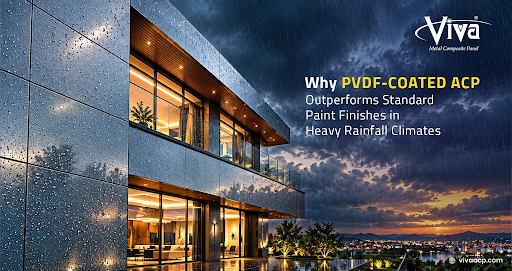
Why PVDF-Coated ACP Outperforms Standard Paint Finishes in Heavy Rainfall Climates
India's monsoon isn't gentle. Cities like Mumbai see over 3,000 mm of rainfall a year, while coastal regions like Kerala, Chennai and Mangalore deal with heavy rain, humidity and salt exposure for much of the year. Add intense pre-monsoon heat and sudden temperature swings, and you have one of the toughest climate combinations any building exterior can face.
For any building exterior, that's a serious, repeated test. It's exactly where the difference between PVDF-coated ACP and standard paint finishes becomes obvious. This guide from Viva ACP explains what happens to these two finishes over time and why PVDF-coated ACP can be a better choice for buildings in India's high-rainfall regions.
The Problem with Standard Paint Finishes in Heavy Rainfall
Traditional painted exteriors, whether on concrete, wood or metal, weren't built for this kind of punishment. Paint is essentially a thin film applied to a surface, and over time, sun, rain, humidity and pollution all work against it. In India's monsoon-heavy regions, that breakdown happens faster than many building owners expect.
Here's what typically happens to a standard painted exterior over just a few monsoon seasons:
Fading and dull, patchy colour: UV exposure breaks down pigment molecules, and repeated rain washes out colour unevenly, leaving a blotchy, aged appearance.
Peeling and cracking: Moisture seeps beneath the paint layer, especially at joints and edges, weakening its bond to the surface until it starts to lift and flake.
Water staining that's difficult to clean off: Monsoon runoff carries dust and pollutants that streak across painted surfaces, leaving marks that don't wash away easily.
Algae and fungal growth: Constant moisture combined with India's warm temperatures creates ideal conditions for algae and mold to take hold on painted exteriors, especially in shaded or poorly ventilated areas.
More frequent repainting and repainting costs: Most painted exteriors in high-rainfall regions need touch-ups or full repaints every 3 to 5 years, sometimes sooner near the coast.
In a country where monsoon returns every single year without fail, these issues aren't occasional. They're expected, which is exactly why more architects and developers are moving away from paint for exterior finishes altogether.
What Makes PVDF Coating Different from Standard Paint?
PVDF (Polyvinylidene Fluoride) is a high-performance coating used on ACP panels, typically formulated with a high concentration of Kynar 500 resin, a fluoropolymer originally developed for extreme-weather industrial applications. Instead of sitting on the surface like a layer of paint, PVDF forms a tightly bonded, chemically stable finish during the panel manufacturing process.
This is a fundamentally different approach to weather protection, and it shows in how the material performs over years of exposure rather than months.
Long-Lasting Colour Retention
PVDF-coated panels are engineered to hold their colour for 25 years or more, even with constant UV exposure and repeated wet-dry cycles. The coating's molecular structure resists the breakdown that causes paint to fade and chalk over time.
Water Doesn't Stick Around
The coated surface has a naturally low affinity for water, meaning rain sheets off rather than pooling or soaking in. This significantly reduces staining, streaking and the kind of water damage that plagues painted exteriors during monsoon season.
Self-Cleaning Behaviour
Because dust and grime don't bond tightly to the coated surface, monsoon rain actually helps keep PVDF-coated ACP panels clean, washing away everyday dirt and pollution instead of trapping it against the surface.
No Swelling, Warping or Corrosion
Unlike wood, which swells and warps with repeated moisture exposure, or untreated metal, which can corrode, ACP with PVDF coating stays dimensionally stable through year after year of wet-dry cycles. This is especially valuable in coastal cities where salt-laden air accelerates corrosion on many other materials.
Resistance to Algae and Fungal Growth
The smooth, non-porous nature of PVDF-coated panels makes it much harder for algae, moss and fungal growth to establish themselves compared to the more porous surface of painted concrete or plaster.
Why PVDF-Coated ACP Matters for Indian Buildings
Every region in India has its own climate challenge. Mumbai's sheer volume of rainfall, Chennai's combination of heat and humidity, coastal cities' relentless salt spray, and the Northeast's near-constant dampness for much of the year all put building exteriors under pressure.
PVDF-coated ACP is tested and formulated to perform across these conditions, which is a big part of why it has become a standard choice for exterior cladding in India, rather than an upgrade reserved only for premium projects.
Architects and developers working across multiple Indian cities also benefit from a single, reliable specification that performs consistently whether the building sits in Mumbai's monsoon corridor, Chennai's humid coastline or Delhi's more seasonal but still significant rainfall.
For projects in Balikashram Road, Ahilyanagar, choosing a suitable exterior finish can make a difference in how the building looks and how much maintenance it needs over time.
Comparing the Real Costs of PVDF-Coated ACP and Paint
On paper, standard paint often looks like the cheaper option, and at the moment of initial application, it usually is. But that comparison changes significantly once you factor in the full lifecycle of the finish.
Standard paint: Lower upfront cost, but repainting every 3 to 5 years in high-rainfall regions, plus scaffolding, labour and building downtime each time.
PVDF-coated ACP: Higher upfront cost, but 25+ years of colour retention with minimal maintenance beyond routine cleaning.
When you add up the cost of repeated repainting, including materials, labour, equipment and disruption to a building's occupants or business operations, PVDF-coated ACP often works out to be the more economical choice over the life of a building, not just the more durable one.
Where PVDF-Coated ACP Makes the Biggest Difference
While every exterior surface benefits from better weather resistance, some situations make the case for PVDF-coated ACP even more compelling:
High-rise buildings: Repainting tall structures is expensive and logistically difficult, making a long-lasting finish especially valuable.
Coastal properties: Salt spray accelerates the breakdown of most conventional finishes, but PVDF-coated ACP is specifically formulated to resist this kind of environmental stress.
Commercial and retail facades: A building's exterior is often its first impression. Fading or peeling paint sends the wrong message to customers and clients.
Public infrastructure: Transport hubs, hospitals and institutional buildings need finishes that hold up under constant use with minimal maintenance windows.
The Bigger Picture: Less Maintenance and Lower Long-Term Cost
While PVDF-coated ACP cost a little more upfront than standard painted finishes, the savings show up later through fewer repaints, less facade maintenance and a building that still looks sharp a decade or two down the line, even after dozens of monsoon seasons.
For any project in a monsoon-heavy region, that's not just a design choice. It's a practical, long-term investment in how a building performs and looks for decades, not just years.
Understanding How PVDF Coating Is Applied
PVDF coating isn't sprayed on after the ACP panel is manufactured. It's applied to the aluminium coil itself through a continuous coil-coating process, before the panel is even formed. The aluminium coil passes through a series of rollers, cleaning stages and curing ovens, where multiple thin layers of PVDF resin are baked onto the surface at high temperatures.
This process creates a much stronger, more uniform bond than hand-applied paint could ever achieve, which is a big part of why the coating performs differently once it's exposed to years of monsoon rain and intense sun. The high-temperature curing process is also what gives PVDF its exceptional resistance to chalking, fading and chemical degradation.
How to Identify Genuine PVDF-Coated ACP
As PVDF-coated ACP has grown in popularity across India, it's become important for architects, contractors and building owners to know how to distinguish genuine PVDF coatings from lower-grade alternatives that are sometimes marketed under similar names.
Ask for the resin content: Genuine PVDF coatings typically use a high concentration of Kynar 500 or similar fluoropolymer resin. Ask your supplier to confirm this percentage.
Request test certificates: Reputable manufacturers can provide weathering and performance test data, often based on international standards like AAMA 2605.
Check the warranty terms: A strong PVDF coating typically comes with a meaningful colour-retention warranty. Vague or short warranties can be a sign of a lower-grade coating.
Compare gloss retention claims: Genuine PVDF coatings are formulated to retain gloss and colour far longer than standard polyester coatings, and manufacturers should be able to back this up with data.
Choosing the Right Panel for Different Parts of a Building
Not every surface on a building faces the same level of weather exposure, and it's worth thinking through where PVDF-coated ACP delivers the most value.
Street-facing facades: These surfaces take the brunt of wind-driven rain and pollution, making them the highest priority for PVDF-coated panels.
Rooftop and upper-floor cladding: Higher sections of a building are more exposed to sun and driving rain, and are also the most expensive and disruptive to repaint later.
Ground-floor and podium levels: While slightly more sheltered, these areas are still exposed to splash-back from monsoon runoff and benefit from the same long-term protection.
Balconies and sun shades: Horizontal or angled surfaces tend to collect standing water during heavy rain, making water-shedding performance especially valuable.
What Architects and Developers Are Increasingly Choosing
Across major Indian cities, there's a clear shift underway. Where painted concrete and plaster finishes were once the default for mid-rise and high-rise buildings, more architects and developers are now specifying PVDF-coated ACP as the standard exterior material, not just for premium projects, but increasingly for mainstream commercial and residential developments as well.
This shift reflects a broader recognition that in a climate as demanding as India's, the true cost of a building material has to include what happens to it over 10, 15 or 20 years of monsoon seasons, not just what it costs to install on day one.
A Practical Checklist Before You Specify Your Facade Finish
If you're weighing PVDF-coated ACP against standard paint for an upcoming project, a few practical questions can help clarify the decision:
How many monsoon seasons will this building need to withstand before its next planned renovation? The longer the horizon, the stronger the case for a coating designed to last decades rather than years.
Is the building in a coastal zone or a region with especially heavy rainfall? These conditions accelerate the breakdown of standard finishes and make the case for PVDF even stronger.
How disruptive would repainting be to occupants or business operations? For hospitals, offices, hotels and retail spaces, the hidden cost of repainting downtime often outweighs the price difference between materials.
What does the building's ownership value more, lowest upfront cost or lowest cost over the building's lifetime? This single question often settles the decision on its own.
For most projects built to last, the answer becomes clear once the full picture, not just the initial invoice, is on the table.
Frequently Asked Questions About PVDF-Coated ACP
How Is PVDF Different from PVC or Standard Polyester Coatings?
PVDF offers significantly better UV and weather resistance than standard polyester coatings, and is generally considered the premium standard for exterior-grade ACP, particularly in demanding climates like India's monsoon regions.
Does PVDF-Coated ACP Need Any Maintenance at All?
Routine cleaning with mild detergent and water is generally all that's needed. Unlike painted surfaces, there's no need for periodic repainting or touch-ups under normal conditions.
Is PVDF-Coated ACP Suitable for Coastal Buildings?
Yes. Its resistance to salt spray and corrosion makes it particularly well-suited for coastal cities, where standard finishes tend to degrade much faster.
How Much More Expensive Is PVDF-Coated ACP Compared to Standard Paint?
Upfront costs are typically higher than paint, but when factored against 20+ years of reduced maintenance and repainting, the total cost of ownership is often lower over the building's lifetime.
Can PVDF-Coated ACP Be Installed on an Existing Painted Building?
Yes. PVDF-coated ACP is commonly used in re-cladding and renovation projects, mounted onto an engineered sub-frame over the existing wall. This makes it a practical way to upgrade an older, paint-finished building's weather resistance without a full structural overhaul.
Conclusion
Choosing the right exterior finish is important for buildings exposed to heavy rainfall, humidity, strong sunlight and coastal conditions. Standard paint may offer a lower initial cost, but repeated repainting, fading, peeling and maintenance can add up over time.
PVDF-coated ACP offers an alternative for building owners, architects and developers looking for long-lasting colour retention, weather resistance and reduced maintenance. For projects in Balikashram Road, Ahilyanagar, considering the long-term performance of facade materials can help make a more practical investment decision.